

H.P. Lovecraft describes the impossible metropolis of the Elder Things like so:
“The effect was that of a Cyclopean city of no architecture known to man or to human imagination, with vast aggregations of night-black masonry embodying monstrous perversions of geometrical laws and attaining the most grotesque extremes of sinister bizarrerie.” — At the Mountains of Madness
Lovecraft would have described at least a portion of “STRAFTAT’s” over 350 maps similarly.
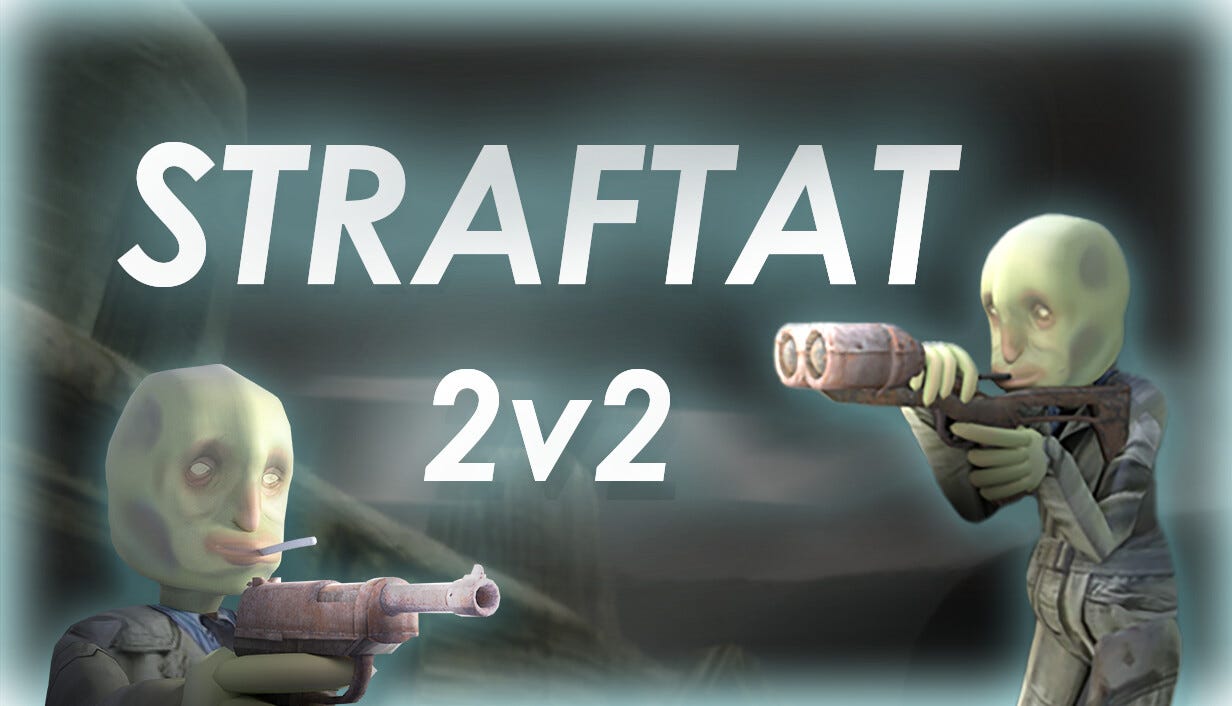
Even though it came out less than two years ago, “STRAFTAT” is a game from a bygone era — the time of “Unreal Tournament” and other arena shooter games. The game is completely non-contextual. You’re dropped into a random map littered with random weapons and 1-3 random people to kill. Rounds unfold at ludicrous speeds, with the vast majority terminating in just a few seconds. Run. Jump. Slide. Shoot. Die. Repeat. The grotesque, perpetually cigarette-chewing characters contort and warp as the players puppet them at maximum momentum. The laws of physics are mostly notional. Some of the many guns are replicas of real-world firearms, while others are completely fantastical. “STRAFTAT” encourages live-wire experimentation, that is, point this unholy monstrosity at your opponent and see what happens.
“STRAFTAT” is a party game for psychos. The ideal player would be virtually spat at in casual lobbies of other games, called a “try-hard,” a “no-lifer,” or a “sweat.” When you only have a few seconds to be mad about being no-scoped from across the map or outgunned by someone who’s been bhopping and walljumping out of the womb, though, does the imbalance really matter?
The answer is no, because you’re too busy trying out the next map, picking up a new gun. Maybe this is the one to give you an edge over that insane guy who’s won the last six games in a row. Oh, he vaporized you with a non-Euclidean laser rifle? “STRAFTAT” giveth, “STRAFTAT” taketh away.
The gameplay of “STRAFTAT” is about as simple as it could possibly be, minus the esoteric movement techniques the sickos use. You play “STRAFTAT” when you and your friends have 30 minutes to kill, or on one side of a boring Zoom meeting. The game is free, and for that price, you get a staggering amount of variety. Investing five bucks gets you even more guns, maps, and cosmetics. The game expects no commitment, but it proffers a dark bargain: To become good at “STRAFTAT” is to become an Elder Thing, an unspeakable monstrosity terrorizing random lobbies and compelling ragequits left and right. Beware.
But enough of that. Let us return to where we began: architecture.
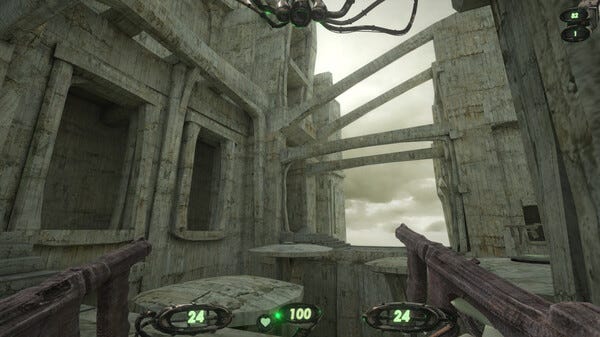
“STRAFTAT” is set in hundreds of spaces. Maps have titles like “Arena_03,” “Bazaar_01,” and “Chateux_11.” Permeating each is a sense of liminality. Many of the maps look old and decayed, with rusty machinery and barren facades and broken-down cars. Others are empty gardens and Grecian temples decorated with marble columns and trimmed greenery. Yet the player also understands that these spaces have no history. They are literally floating in a void, popping out of existence as soon as the last ragdoll hits the pavement. If one were to enter one of these maps alone, they’d be greeted with hollow shops bartering no wares, apartments with no tenants, factories that produce nothing. The grubbiness recalls City 17 from “Half-Life 2” and the decrepit industrial hellscape of “Tetsuo: the Iron Man.” Brown, gray, beige is the color palette of “STRAFTAT,” plus the dark crimson of early aughts blood. The developers of “STRAFTAT” previously made a game called “BABBDI,” about exploring a city with the same eeriness of “STRAFTAT.” That game didn’t have the guns, though.
Bullet holes and blood splatters are an easy way to add character to space. To make it feel lived in.
“Greatness consists in bringing all Manner of Mischief on Mankind,” — Henry Fielding, Jonathan Wild